Buyer's guide

The best HVAC software, sorted by the shop it actually fits

There is no single best platform — there is the right one for your headcount, your office staff and your field workflow. Here is how to tell them apart.

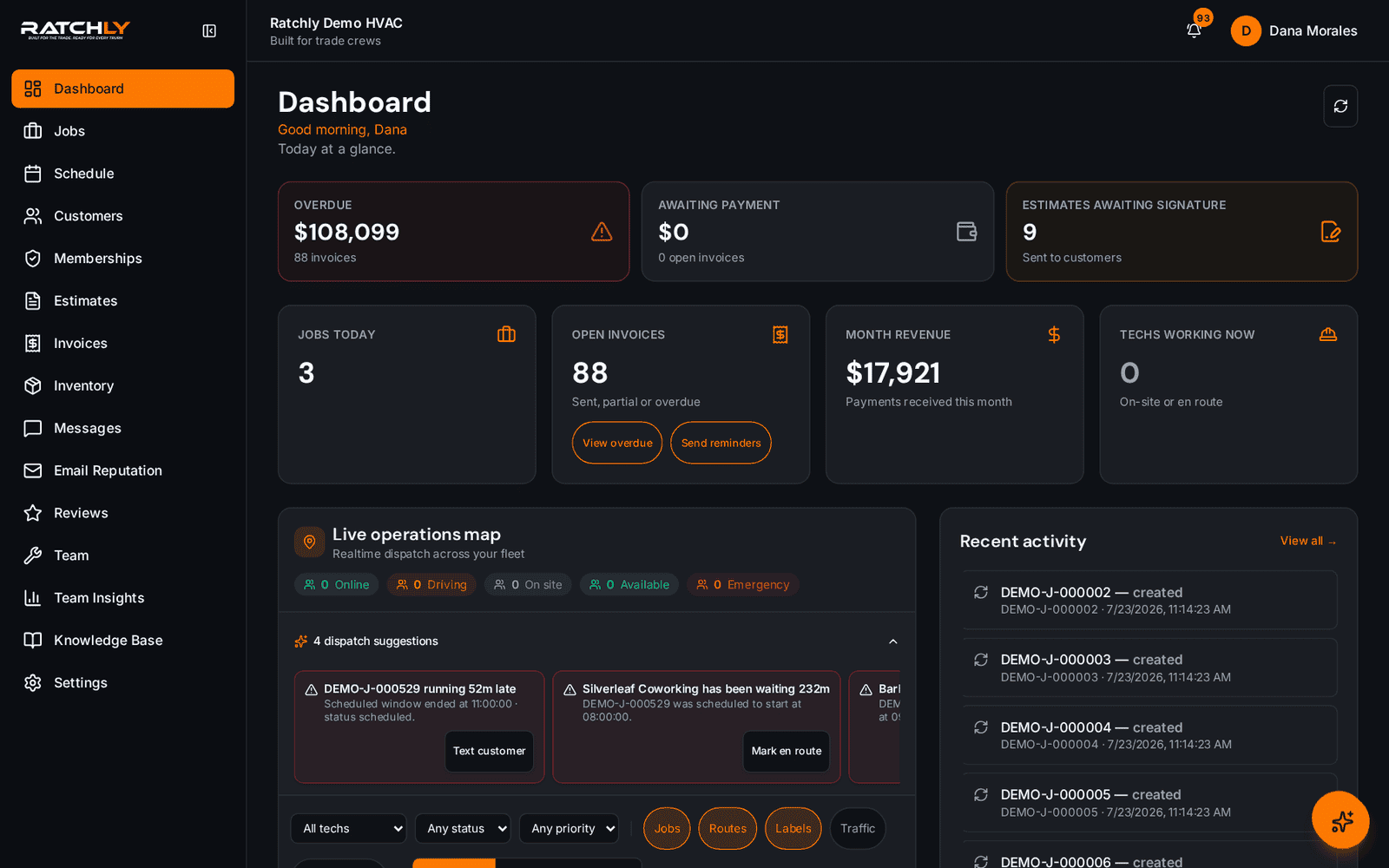
Ratchly dashboard with the day's jobs and revenue at a glance.

Most HVAC software lists rank vendors as though every contractor is the same. They are not. A five-technician residential service shop and a forty-truck commercial contractor with a call center need genuinely different software, and the wrong pick fails in opposite directions: too heavy to adopt, or too light to run the business.

This guide sorts the market by the size and shape of the business rather than by a score. We build one of these products, so treat our entry accordingly — the criteria below are the part worth borrowing.

The short answer

Choose Ratchly if

  • Built for 1–10 technician HVAC shops, not enterprise contractors
  • Estimate → signature → invoice → payment on the technician's phone
  • Drag-and-drop dispatch board with live technician locations
  • Maintenance agreements that auto-generate their visits
  • Flat, published pricing with no implementation fee

Choose another platform if

  • You run multiple trades or multiple branches
  • You have dedicated dispatch or office staff
  • You need enterprise reporting and integrations

How we judged these

  • Time from technician arrival to paid invoice, measured on a phone
  • Whether dispatch changes take seconds or a phone call
  • Whether maintenance agreements schedule themselves
  • All-in cost including onboarding, add-ons and processing fees
  • How long until a new technician can use it without training

The options, by who they fit

01

Ratchly — small HVAC shops (1–10 techs)

Owner-operators and small crews with no dedicated office staff.

Strengths
  • Built for 1–10 technician HVAC shops, not enterprise contractors
  • Estimate → signature → invoice → payment on the technician's phone
  • Drag-and-drop dispatch board with live technician locations
  • Maintenance agreements that auto-generate their visits
  • Flat, published pricing with no implementation fee
Watch out for
  • HVAC-first — other trades work, but the defaults are HVAC
  • No enterprise procurement, franchise rollup or call-center modules
02

ServiceTitan — large contractors

Multi-location contractors with call centers and dedicated ops staff.

Strengths
  • Depth of reporting and capacity planning
  • Tooling designed around a call center
  • Built for businesses with someone administering the system
Watch out for
  • Heavier than a small shop can usually operate
  • Expect an implementation project rather than a self-serve signup
03

Housecall Pro — mixed-trade home services

Businesses running several trades under one brand.

Strengths
  • Broad coverage across home-service trades
  • Large add-on and integration ecosystem
Watch out for
  • HVAC-specific workflows may need configuring
  • Breadth you may not use
04

Jobber — small service businesses generally

Small teams that want a polished generalist.

Strengths
  • Clean quoting and client communication
  • Well-established, widely supported
Watch out for
  • Not HVAC-specific by default
05

FieldEdge — established HVAC and plumbing shops

Contractors with office staff and settled accounting workflows.

Strengths
  • Long HVAC track record
  • Suited to a back-office-led operation
Watch out for
  • Less appealing if you have no office staff at all

Questions contractors ask

What is the best HVAC software for a one-person shop?
Pick the lightest tool that still handles estimates, invoicing and payment on a phone. Anything that needs an implementation project will not survive your first busy week.
How much should HVAC software cost?
Judge it against one recovered job per month. If the platform stops a single missed invoice or unbooked agreement visit, most small-shop pricing pays for itself.
How do I evaluate a platform fairly?
Run one real week of work through the trial. Do not evaluate on a scripted demo — evaluate on your own messy Tuesday.

Test it on one real week

Load your customers, put this week's jobs on the board, and see how long it takes to go from arrival to a paid invoice. That comparison beats any table.