Buyer's guide

Best HVAC software for small business owners

With no office staff, the software has to do the admin. Anything that adds admin is a downgrade, however impressive the demo.

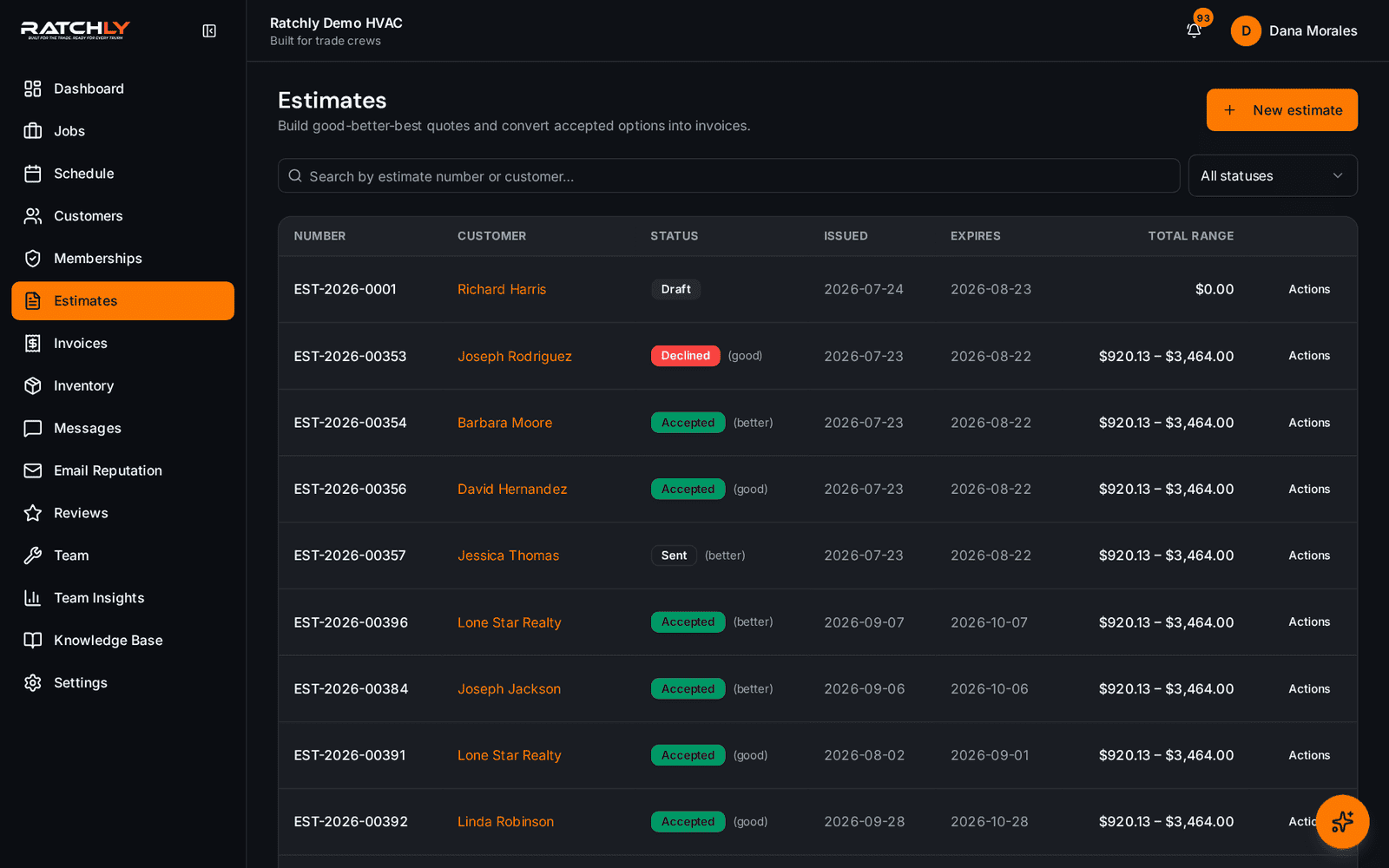
Ratchly estimate list showing sent, approved and declined quotes.

A small HVAC business does not have a dispatcher, a bookkeeper and an ops manager. It has an owner who is also on the tools. That single fact should decide the software: every feature that requires someone to maintain it is a liability, not an asset.

Prioritise the four things that leak money in a small shop — unbooked agreement visits, estimates that never get followed up, invoices raised late, and reviews never asked for. Ignore everything else until those are solved.

The short answer

Choose Ratchly if

  • Setup in an afternoon with no implementation fee
  • Follow-ups, agreement visits and review requests handled automatically
  • A technician app that works with gloves on and poor signal
  • Flat published pricing you can budget against

Choose another platform if

  • You are already at 15+ technicians and growing quickly
  • You need multi-branch or franchise structures

How we judged these

  • Can it be set up without help
  • Does it reduce admin rather than move it
  • Does it chase the four leaks: agreements, estimates, invoices, reviews
  • Is the total monthly cost predictable

The options, by who they fit

01

Ratchly

1–10 technician HVAC shops with no back office.

Strengths
  • Built for 1–10 technician HVAC shops, not enterprise contractors
  • Estimate → signature → invoice → payment on the technician's phone
  • Drag-and-drop dispatch board with live technician locations
  • Maintenance agreements that auto-generate their visits
  • Flat, published pricing with no implementation fee
Watch out for
  • HVAC-first — other trades work, but the defaults are HVAC
  • No enterprise procurement, franchise rollup or call-center modules
02

Generalist FSM tools

Small mixed-trade businesses.

Strengths
  • Trade-agnostic, well supported
Watch out for
  • HVAC agreements and equipment history need building
03

Spreadsheets and a whiteboard

A genuinely one-person operation doing a few jobs a week.

Strengths
  • Free
  • No learning curve
Watch out for
  • Breaks at around 15–20 jobs a week
  • No audit trail when a customer disputes work

Questions contractors ask

When is a small shop ready for software?
When you have missed something that cost you money — a forgotten agreement visit, an uninvoiced job, an estimate nobody followed up. That is the point where the tool pays for itself.
How long does setup take?
Plan an afternoon: import customers, add technicians, put this week's jobs on the board, then run it live.

Test it on one real week

Load your customers, put this week's jobs on the board, and see how long it takes to go from arrival to a paid invoice. That comparison beats any table.